
Foto GSL/ISG© 2026 All rights reserved
ISG-Magazin 2025/4
STADTPARTERRE: WIRTSCHAFT & KULTUR
Diese Frage begleitet jede Form von Stadtentwicklung. Urbanität ist weit mehr als dicht bebaute Stadt: Sie ist ein pulsierendes Geflecht aus Geschichte und Vielfalt, aus Begegnungen und Austausch, aus Mobilität und stetigem Wandel. Identität entsteht dort, wo Räume nicht nur gebaut, sondern belebt werden. Wo Stadtgestaltung nicht allein technische Effizienz verfolgt, sondern Orte schafft, die unverwechselbar sind – Orte, die Menschen zusammenbringen, Geschichten erzählen und Zukunft ermöglichen.
Wenn Menschen sich mit Orten verbinden – durch Erinnerungen, durch gelebte Kultur und soziale Praktiken, durch sichtbare Spuren der Vergangenheit und durch Räume, die Offenheit und Teilhabe ermöglichen – dann wächst Identität. Städte sind lebendige Organismen. Sie verändern sich mit neuen Quartieren, moderner Infrastruktur, dem Wandel von Arbeit, Mobilität und Klima. Die Herausforderung liegt darin, diese Transformation so zu gestalten, dass sie nicht zur Entwurzelung führt, sondern neue Identität schafft.
Dafür braucht es eine Balance zwischen Kontinuität und Innovation: Geschichte als Ressource begreifen, ihre Spuren in die Zukunft überführen und zugleich Strukturen schaffen, die flexibel auf neue Bedürfnisse reagieren. So kann die Authentizität und Materialität unseres kulturellen Erbes bewahrt werden, während zeitgenössische Architektur und neue Nutzungen ihren Platz finden. Denn Identität ist kein starres Konzept – sie entfaltet sich im Spannungsfeld von Schutz und Entwicklung.
HOW DO OUR CITIES DEVELOP THEIR IDENTITY, AND HOW CAN WE PRESERVE IT?
This question arises with every form of urban development. Urbanity represents much more than just a densely built-up city: it is a vibrant tapestry of history and diversity, encounters and interactions, mobility and constant change. Identity originates from spaces that are not only constructed, but also brought to life. It can be found where urban design does not solely pursue technical efficiency, but instead creates distinctive places that bring people together, tell stories, and enable a vision of the future.
Identity evolves when people form connections with places through memories, lived culture and social practices, visible traces of the past, and spaces that encourage openness and participation. Cities are living organisms. They are changing with developments such as new quarters, modern infrastructure, and shifts in work, mobility and climate. The challenge lies in shaping this transformation to ensure it does not result in uprooting, but instead creates a new identity.
This requires a balance between continuity and innovation: embracing history as a resource and carrying its legacy forward while also establishing flexible structures that can adapt to new needs. This approach allows us to preserve the authenticity and materiality of our cultural heritage while accommodating contemporary architecture and new uses. After all, identity is not a rigid concept; it evolves through the interplay of protection and development.
I hope you enjoy reading this issue. Sincerely yours
Ich wünsche Ihnen eine spannende Lektüre. Ihre
Mag.a Judith Schwentner
ISG-Präsidentin und Bürgermeisterin-Stellvertreterin der Landeshauptstadt Graz
ISG President und Deputy Mayor of the City of Graz
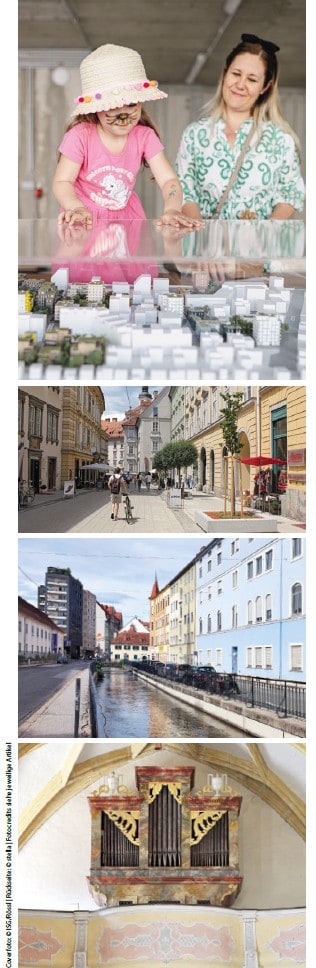
Gertraud Strempfl-Ledl S. 4
STADTPARTERRE AUF AUGENHÖHE: EIN RESÜMEE
The urban parterre at eye level: a summary
Cornelia Bredt S. 9
STADTRAUMAKTIVIERUNG
Urban space activation
Michael Stvarnik S. 14
DAS STADTPARTERRE ALS SCHLÜSSELZONE FÜR MEHR LEBENSQUALITÄT
The urabn parterre as a key area for improving quality of life
Bertram Werle, Gertraud Strempfl-Ledl S. 18
WELTERBE IN GRAZ: 20. JUBILÄUMSKONFERENZ
World Heritage in Graz: 20th Anniversary Conference
Katharina Eisch-Angus, Erika Thümmel S. 24
POTENTIAL UND RESSOURCE: DIE INDUSTRIEERBE-LANDSCHAFT AM MÜHLGANG
Potential and resource: the industrial heritage landscape along the mill canal
Gabriele Schnabl S. 30
DER STYRER WEHRGRABEN
The Wehrgraben in Steyr
Reinhard Böllmann, Hans Kolb S. 36
DIE ÄLTESTE ORGEL DER STEIERMARK
Styria`s oldest organ